One of the most important decisions ocean shippers can make is which carrier their cargo will sail on. The decision to ship on one carrier versus another could cause massive headaches in the form of delayed shipments at transshipment hubs, longer than necessary routes, or a higher price for a service you do not need.
Before choosing a carrier for your segment, be sure to prioritize the importance of transit time, price, and reliability, to the success of your business. Once you’ve done so, it will be easier to choose the best ocean shipping carrier to satisfy your supply chain needs.
Keep in mind, carrier preference will change based on your lead time and budgetary requirements. What works for your supply chain today, might not in the future.
China to US East Coast Routes
- Maersk Transpacific 7 (TP7)
- Maersk TP10 Eastbound
- Maersk TP11 Eastbound
- CMA CGM Manhattan Bridge
- China Shipping AAE2
- China Shipping AAE3
- MSC America Westbound
- MSC Everglades Eastbound
- Evergreen/MOL AUE3
- CMA CGM Columbus Loop
Maersk Transpacific 7 (TP7)
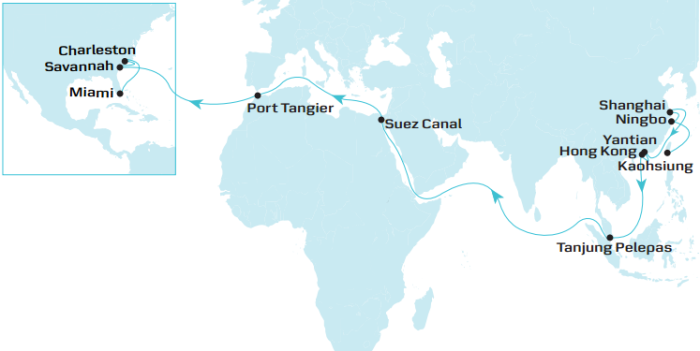
Ports of Call
- Kaohsiung, Taiwan
- Ningbo, China
- Shanghai, China
- Yantian, China
- Hong Kong, Hong, Kong
- Tanjung Pelepas, Malaysia
- Suez Canal, Egypt
- Port Tangier, Morocco
- Savannah, GA, USA
- Charleston, SC, USA
- Miami, FL, USA
Transit time to Miami: 41 days
Pros: A cost-effective and reliable service, Maersk TP7 is known for being on schedule. The vessel travels through the Suez Canal, which has cheaper tolls than the Panama Canal.
Cons: The toll savings of the Suez Canal means added transit time when compared to Panama Canal routed vessels.
When should I ship on TP7? This is a very reliable Maersk service that shippers should use when looking for a moderate service in both price and transit time.
Maersk TP10 Eastbound
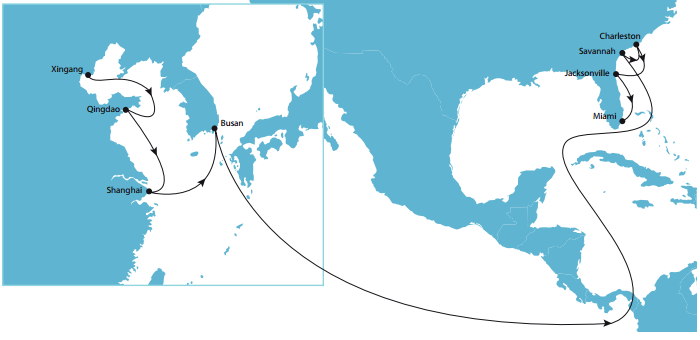
Ports of Call
- Xingang, China
- Qingdao, China
- Shanghai, China
- Busan, South Korea
- Savannah, GA, USA
- Charleston, SC, USA
- Jacksonville, FL, USA
- Miami, FL, USA
Transit time to Miami: 35 days
Pros: Traveling through the Panama Canal, this route has the shortest transit time to Miami compared to Maersk’s other vessels.
Cons: The time savings will come with slightly higher rates.
When should I use TP10? If you are interested in a slightly faster transit time than the TP7 service, but still want the Maersk reliability.This is also the only vessel currently offering direct coverage out of Xingang.
Maersk TP11 Eastbound
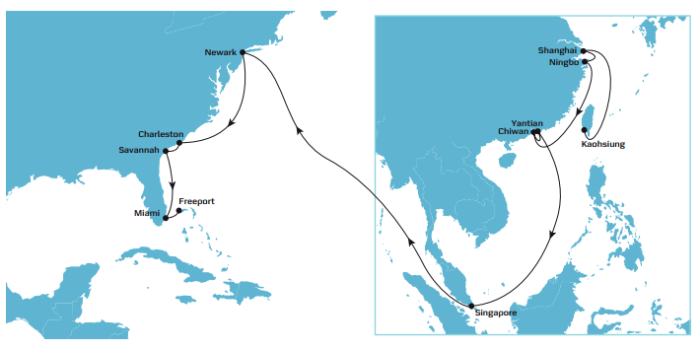
Ports of Call
- Kaohsiung, Taiwan
- Ningbo, China
- Chiwan, China
- Yantian, China
- Singapore
- Newark, NJ, USA
- Charleston, SC, USA
- Savannah, GA, USA
- Miami, FL, USA
- Freeport, Bahamas
Transit time to Miami: 43 days
Pros: The only direct service offering from Yantian and Singapore to Miami. More cost efficient than TP10 because the vessel travels through the Suez Canal.
Cons: This vessel has the longest transit time from China to Miami out of all that are mentioned in this article.
When should I use TP11? Shippers should use this Maersk service if they have products in both Yantian and Singapore, are not under a tight deadline, and want a reliable service with lower rates.
CMA CGM Manhattan Bridge
Ports of Call
- Qingdao, China
- Ningbo, China
- Shanghai, China
- New York, NY, USA
- Norfolk, VA, USA
- Savannah, GA, USA
- Miami, FL, USA
- Qingdao, China
Transit time to Miami: 35 days
Pros: The most direct ocean shipping loop from China to the U.S. East Coast going through the Panama Canal, making transit shorter from Asia to U.S. East Coast.
Cons: Rates for this service are slightly higher than carriers that opt for the Suez Canal.
When should I ship on Manhattan Bridge? Shippers should ship goods on this CMA service when the freight needs to get from China to the U.S. East Coast as soon as possible. Shippers should also be prepared to pay a premium for the added convenience of short transit time.
China Shipping AAE2
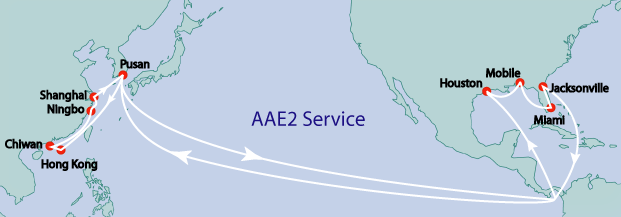
Ports of Call
- Hong Kong, Hong Kong
- Chiwan, China
- Ningbo, China
- Shangai, China
- Pusan, Korea
- Houston, TX, USA
- Mobile, AL, USA
- Miami, FL, USA
- Jacksonville, FL, USA
Transit time to Miami: 34 days
Pros: This ocean freight vessel also travels through the Panama Canal without a U.S. West Coast stop and travels to the Gulf Coast and also includes Korea at origin. This is currently the quickest transit time to Miami.
Cons: Rates will be higher due to the quicker transit time.
When should I ship on AAE2? Shippers needing a direct ocean route with no transshipments should consider this service. For importers on the Gulf Coast, this service is ideal as the cargo arrives directly via the port versus rail. Railing 20 foot ocean shipping containers from the U.S. West Coast to the Gulf Coast require a “pair” to fill the full 40 foot slit and the freight will sit at the rail yard until another 20 foot container is ready for transit on that same route. This service cuts that concern out of the equation completely.
China Shipping AAE3
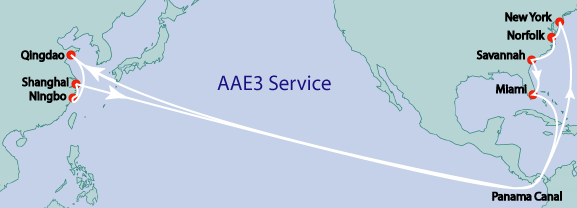
Ports of Call
- Qingdao, China
- Ningbo, China
- Shanghai, China
- New York, NY, USA
- Norfolk, VA, USA
- Savannah, GA, USA
- Miami, FL, USA
Transit time to Miami: 35 days
Pros: This vessel reduces overall transit time by traveling through the Panama canal and making minimal stops at top ports in China.
Cons: With so few ports serviced in China, this vessel may not get close enough to a supplier’s location.
When should I ship on AAE3? If your supplier is located near one of these three China ports and you are willing to spend more in exchange for this quicker transit time.
MSC America Westbound
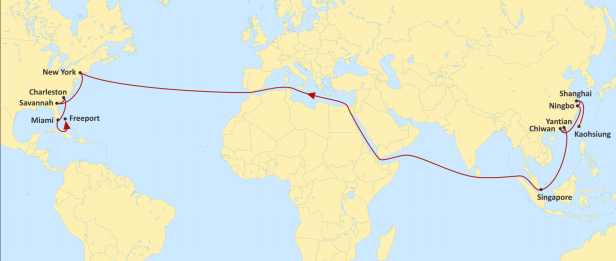
Ports of Call
- Kaohsiung, China
- Shanghai, China
- Ningbo, China
- Chiwan, China
- Yantian, China
- Singapore
- Newark, NJ, USA
- Savannah, GA, USA
- Charleston, SC, USA
- Miami, FL, USA
- Freeport, Bahamas
Transit time to Miami: 42 days
Pros: MSC shares a vessel with Maersk for this route, so it is a reliable service that also offers cost savings by traveling through the Suez Canal.
Cons: Transit time will be slower than other options.
When should I ship on MSC? This route is a great option for shippers who are not under a tight deadline and are looking for a cost efficient, reliable service.
MSC Everglades Eastbound
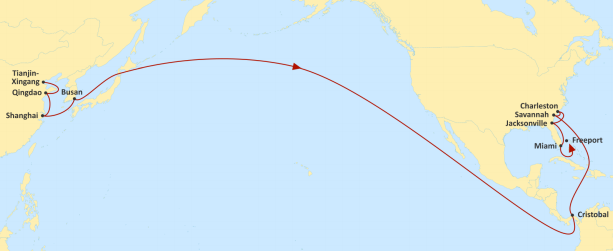
Ports of Call
- Xingang, China
- Qingdao, China
- Shanghai, China
- Busan, South Korea
- Savannah, GA, USA
- Charleston, SC, USA
- Jacksonville, FL, USA
- Miami, FL, USA
- Freeport, Bahamas
Transit time to Miami: 35 days
Pros: Traveling through the Panama Canal, this MSC service offers an improved transit time when compared to their America Westbound route.
Cons: Cost will be higher than other services that opt for the Suez Canal.
When should I use MSC? This MSC service also shares a vessel with Maersk, offering a reliable, quick service for shippers who are interested in taking advantage of the faster transit time.
Evergreen/MOL AUE3
Ports of Call
- Hong Kong, Hong Kong
- Yantian, China
- Singapore
- Suez Canal, Egpyt
- Norfolk
- Savannah, GA, USA
- Jacksonville, FL USA
- Charleston, SC, USA
Transit time to Charleston: 38 days
Pros: This service is operated by two ocean carriers (Evergreen and MOL). AUE3 is a cost-efficient and reliable option traveling through the Suez Canal.
Cons: The joint service is slightly slower than Maersk’s TP7 service and the transit time is longer than vessels traveling through the Panama Canal.
When should I ship on AUE3? As with the TP7, this is another reliable (albeit slightly longer in transit time) option that also passes through the Suez Canal. If transit time is not of the utmost importance, the AUE3 is a viable option for shippers.
CMA CGM Columbus Loop
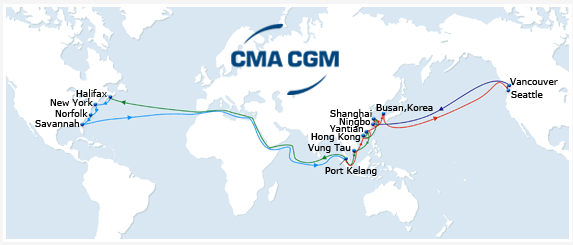
Ports of Call
- Ningbo, China
- Shanghai, China
- Hong Kong, Hong Kong
- Yantian, China
- Vung Tau, Vietnam
- Port Kelang, Malaysia
- Halifax, NS, Canada
- New York, NY, USA
- Norfolk, VA, USA
- Savannah, GA, USA
Transit time to Savannah: 40 days
Pros: With this CMA service, there are more loading points in Asia as compared to the Manhattan Bridge service.
Cons: This ocean shipping route has slightly longer transit times.
When should I ship on Columbus Loop? This service is ideal for shippers who require additional loading port options in Asia.
Editor’s Note: This post was originally published in September 2013 and was updated for accuracy in February 2016.