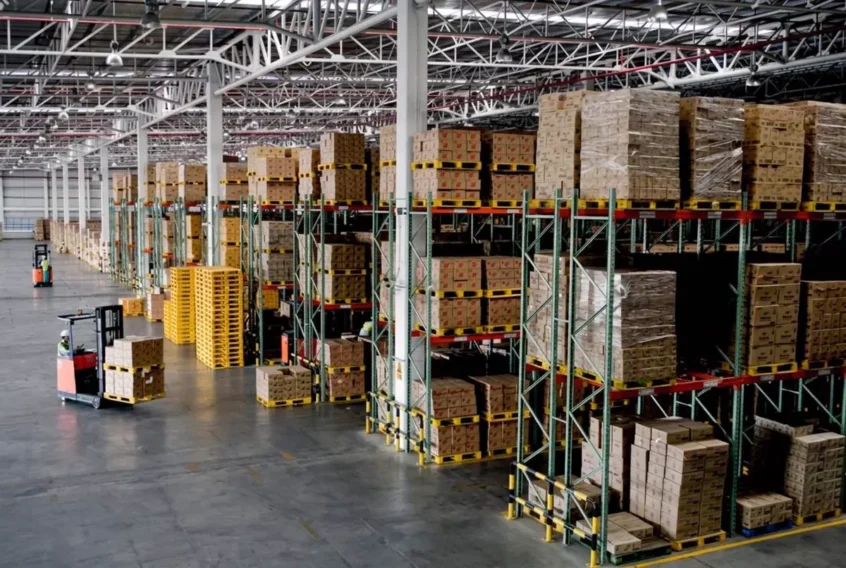
Amazon now runs more than a million robots. Yet most warehouses still move boxes by hand; in one 2025 survey, 63% of facilities described themselves as fully manual. That gap between the headline robots and the everyday reality is what makes warehouse automation statistics so easy to misquote. We pulled the numbers straight from the sources, including the U.S. Bureau of Labor Statistics (BLS), the Census Bureau, the International Federation of Robotics (IFR), MHI, Gartner, and McKinsey, and linked every one so you can check it yourself.
Key Warehouse Automation Statistics at a Glance
- Amazon has deployed more than 1 million robots across a network of more than 300 facilities worldwide. (Amazon, 2025)
- 63% of surveyed warehouses are fully manual, 31% are partially automated, and just 6% are highly automated. (Kardex, Modern Materials Handling, and Peerless Research Group, 2025)
- The global warehouse automation market is valued at $34.17 billion in 2026 and is projected to reach $65.74 billion by 2031. (Mordor Intelligence, 2026)
- 117,500 transport and logistics robots were sold worldwide in 2025, up 21% and representing 47% of all professional service robots. (International Federation of Robotics, 2026)
- U.S. warehousing and storage recorded 4.8 injury and illness cases per 100 full-time workers in 2024. (U.S. Bureau of Labor Statistics, 2026)
- By 2030, 50% of new warehouses in developed markets are predicted to be designed as robot-centric facilities where humans are optional. (Gartner, 2026)
Warehouse Automation Market Size and Growth
Research firms agree the market is growing fast, but they disagree on how fast, so each forecast below names its source.
- The global warehouse automation market is valued at $34.17 billion in 2026 and is projected to reach $65.74 billion by 2031, a 13.98% compound annual growth rate (CAGR). (Mordor Intelligence, 2026)
- The North America warehouse automation market is expected to grow from $9.33 billion in 2026 to $19.97 billion by 2031, a 16.45% CAGR. (Mordor Intelligence, 2026)
- The global warehouse automation market is expected to reach about $64 billion by 2032, growing at a 12.3% CAGR between 2026 and 2032. (LogisticsIQ, 2026)
- The warehouse robotics market is projected to grow from $7.35 billion in 2026 to $25.41 billion by 2034, a 16.80% CAGR. (Fortune Business Insights, 2026)
- Global warehouse automation order intake grew 7% year over year in 2025. (Interact Analysis, 2026)
- The U.S. had 23,848 private warehousing and storage establishments in the first quarter of 2026 (preliminary). (U.S. Bureau of Labor Statistics, 2026)
How the major forecasts compare
| Source | Scope | Forecast | CAGR |
|---|---|---|---|
| Mordor Intelligence (2026) | Global warehouse automation | $65.74B by 2031 | 13.98% |
| LogisticsIQ (2026) | Global warehouse automation | ~$64B by 2032 | 12.3% |
| Mordor Intelligence (2026) | North America warehouse automation | $19.97B by 2031 | 16.45% |
| Fortune Business Insights (2026) | Global warehouse robotics only | $25.41B by 2034 | 16.80% |
Why it matters: forecasts differ mainly because of scope (all automation versus robotics only) and end year, so always cite the firm and the horizon together.
Warehouse Automation Adoption Rates
Despite the hype, most facilities are still early in their automation journey, and full automation of core tasks remains rare.
- 63% of surveyed warehouses are fully manual, 31% are partially automated, and just 6% are highly automated. (Kardex, Modern Materials Handling, and Peerless Research Group, 2025)
- 49% of surveyed companies use conveyor and sortation systems, and 51% plan to implement them within the next two years. (Modern Materials Handling and Peerless Research Group, 2026)
- 48% of surveyed companies currently use goods-to-person picking systems. (Modern Materials Handling and Peerless Research Group, 2026)
- 36% of surveyed companies currently use automated storage systems such as automated storage and retrieval systems (AS/RS) and mini-loads. (Modern Materials Handling and Peerless Research Group, 2026)
- 35% of surveyed companies currently use automatic guided vehicles (AGVs). (Modern Materials Handling and Peerless Research Group, 2026)
- Only 12% of companies report fully automated picking, and just 3% report fully automated retrieval. (Modern Materials Handling and Peerless Research Group, 2026)
- Interact Analysis predicts that by 2030, only 13% of warehouses worldwide will have deployed at least one fulfillment autonomous mobile robot (AMR). (Interact Analysis, 2025)
Warehouse Robot Statistics
Logistics is the single biggest use case for professional service robots, and mobile robot fleets are growing by double digits each year.
- 117,500 transport and logistics robots were sold worldwide in 2025, up 21% and representing 47% of all professional service robots. (International Federation of Robotics, 2026)
- Global shipments of professional service robots rose 24% to almost 250,000 units in 2025. (International Federation of Robotics, 2026)
- Robot-as-a-Service (RaaS) sales of transport and logistics robots grew 42% in 2024. (International Federation of Robotics, 2025)
- North American companies ordered 36,766 robots valued at $2.25 billion in 2025, a 6.6% increase in units over 2024. (Association for Advancing Automation, 2026)
- Collaborative robots accounted for 7,212 units, or 19.6% of all robots ordered in North America in 2025. (Association for Advancing Automation, 2026)
- The global installed base of mobile robots is predicted to exceed 4.2 million units by 2030. (Interact Analysis, 2025)
- Mobile robot shipments are predicted to keep growing at 20% to 30% a year. (Interact Analysis, 2025)
Warehouse Automation Statistics: Labor, Jobs, and Productivity
Warehouses still depend on nearly 2 million workers, while labor shortages and flat productivity push operators toward machines.
- U.S. warehousing and storage employed 1,837,400 workers in August 2026 (seasonally adjusted, preliminary). (U.S. Bureau of Labor Statistics, 2026)
- Stock clerks and order fillers held 457,740 jobs in U.S. warehousing in 2025, more than any other occupation BLS highlights for the industry. (U.S. Bureau of Labor Statistics, 2026)
- Average hourly earnings in U.S. warehousing and storage were $26.74 in July 2026 (preliminary). (U.S. Bureau of Labor Statistics, 2026)
- Employment of hand laborers and material movers is projected to grow 4% from 2025 to 2035, with about 904,200 openings each year. (U.S. Bureau of Labor Statistics, 2026)
- Labor productivity in U.S. warehousing fell 11.5% in 2021, 11.0% in 2022, and 4.4% in 2023 before edging up 0.1% in 2024. (U.S. Bureau of Labor Statistics, 2026)
- Capital input in U.S. warehousing grew 4.8% in 2024, while labor input grew just 0.5%. (U.S. Bureau of Labor Statistics, 2026) Why it matters: capital growing roughly 10 times faster than labor is a sign warehouses are spending on equipment and systems rather than headcount.
- 76% of supply chain and logistics leaders face notable workforce shortages, and 56% report shortages in warehouse operations. (Descartes Systems Group, 2024)
- Amazon’s advanced robotics facilities require 30% more employees in reliability, maintenance, and engineering roles. (Amazon, 2025)
Warehouse Safety Statistics
Warehousing is one of the more injury-prone industries in the U.S., which is one reason safety sits alongside labor as an automation driver.
- U.S. warehousing and storage recorded 4.8 injury and illness cases per 100 full-time workers in 2024. (U.S. Bureau of Labor Statistics, 2026) Why it matters: that is more than double the private industry rate of 2.3 cases per 100 full-time workers in 2024 (U.S. Bureau of Labor Statistics, 2025).
- 4.1 of every 100 full-time U.S. warehouse workers had an injury or illness requiring days away, job restriction, or transfer in 2024. (U.S. Bureau of Labor Statistics, 2026)
- U.S. warehousing had 1.5 cases involving days away from work per 100 full-time workers in 2024. (U.S. Bureau of Labor Statistics, 2026)
- 32 U.S. warehousing and storage workers died from work-related incidents in 2024, up from 28 in 2023. (U.S. Bureau of Labor Statistics, 2026)
- On July 31, 2026, the Occupational Safety and Health Administration (OSHA) began inspections under its updated National Emphasis Program on warehousing and distribution centers. (OSHA, 2026)
Warehouse Automation Investment, Costs, and ROI
Automation budgets are rising, and most companies that have invested say the projects paid off.
- Companies plan to raise automation to 25% of capital spending on average over the next five years. (McKinsey & Company, 2023)
- In logistics and fulfillment, automation is expected to account for more than a third of capital spending, the largest share of any sector. (McKinsey & Company, 2023)
- Pay-per-pick models, in which the vendor keeps ownership of the equipment, can reduce automation project capital costs by 60% to 80%. (McKinsey & Company, 2023)
- 56% of supply chain organizations plan to increase innovation spending, and 52% expect to spend more than $1 million. (MHI, 2026)
- 17% of supply chain organizations plan to invest more than $10 million in supply chain innovation. (MHI, 2026)
- Companies plan to spend an average of $1.6 million on automation in 2026, up from $1.5 million in 2025. (Modern Materials Handling and Peerless Research Group, 2026)
- 65% of surveyed warehouse leaders say their automation met or exceeded ROI expectations, while 10% say it fell short. (Kardex, Modern Materials Handling, and Peerless Research Group, 2025)
Warehouse Automation Integration and Software Statistics
Buying the robots is the easy part. Getting systems to talk to each other is where many warehouses stall.
- Only 23% of warehouses report fully integrated systems, while 62% are partially integrated and 15% are not integrated at all. (Kardex, Modern Materials Handling, and Peerless Research Group, 2025)
- 75% of warehouse leaders agree that integration is essential to unlocking the benefits of automation. (Kardex, Modern Materials Handling, and Peerless Research Group, 2025)
- 64% of warehouses say their software systems are only partially connected, and just 32% say their software and data flow are fully integrated. (Kardex, Modern Materials Handling, and Peerless Research Group, 2025)
- 57% of surveyed companies use a warehouse management system (WMS) for central control of operations. (Modern Materials Handling and Peerless Research Group, 2026)
What Drives Warehouse Automation: E-Commerce and Labor Costs
Online orders keep climbing, and labor keeps getting harder to find, which together explain most automation spending.
- U.S. retail e-commerce sales reached an estimated $340.2 billion in the second quarter of 2026 (seasonally adjusted). (U.S. Census Bureau, 2026)
- E-commerce accounted for 17.1% of total U.S. retail sales in the second quarter of 2026. (U.S. Census Bureau, 2026)
- U.S. e-commerce sales in the second quarter of 2026 were up 12.2% from the second quarter of 2025. (U.S. Census Bureau, 2026)
- Retail and e-commerce accounted for 28.41% of global warehouse automation spending in 2025, the largest end-user share. (Mordor Intelligence, 2026)
- Around half of supply chain professionals cite rising labor costs as a notable reason for investing in robotics. (Gartner, 2024)
Amazon and Walmart Warehouse Automation Facts
The two largest U.S. retailers show what automation looks like at full scale.
- Amazon has deployed more than 1 million robots across a network of more than 300 facilities worldwide. (Amazon, 2025)
- Amazon’s DeepFleet AI model is expected to improve the travel efficiency of its robotic fleet by 10%. (Amazon, 2025)
- About 60% of Walmart’s U.S. stores receive some level of freight from automated distribution centers. (Walmart, 2026)
- About 50% of Walmart’s e-commerce fulfillment center volume is automated. (Walmart, 2026)
- 23 of Walmart’s 42 regional distribution centers are in various stages of automation retrofit. (Walmart, 2026)
The Future of Warehouse Automation: Predictions and Trends
Analysts expect robots to move from add-on tools to the foundation of new warehouse design within this decade.
- By 2030, 50% of new warehouses in developed markets are predicted to be designed as robot-centric facilities where humans are optional. (Gartner, 2026)
- By 2030, one in 20 supply chain managers will manage robots rather than humans. (Gartner, 2025)
- By 2027, 10% of new intralogistics smart robots sold will be humanoid working robots. (Gartner, 2024)
- 73% of supply chain leaders expect to adopt robotics and automation within five years. (MHI, 2026)
- 39% of supply chain leaders rate the disruptive impact of robotics and automation as significant or greater, up 16 percentage points from the previous year. (MHI, 2026)
Methodology and Sources
Every statistic on this page was checked against the original publisher’s page in September 2026, with preference given to government agencies, trade associations, and research firms that disclose their survey methods. Figures are reported exactly as published, and secondary citations were traced back to the primary source wherever it was reachable.
- U.S. Bureau of Labor Statistics, “Warehousing and Storage: NAICS 493,” Industries at a Glance, 2026. https://www.bls.gov/iag/tgs/iag493.htm
- U.S. Bureau of Labor Statistics, “Employer-Reported Workplace Injuries and Illnesses, 2023-2024,” 2025. https://www.bls.gov/news.release/osh.nr0.htm
- U.S. Bureau of Labor Statistics, “Hand Laborers and Material Movers,” Occupational Outlook Handbook, 2026. https://www.bls.gov/ooh/transportation-and-material-moving/hand-laborers-and-material-movers.htm
- U.S. Census Bureau, “Quarterly Retail E-Commerce Sales, 2nd Quarter 2026,” 2026. https://www.census.gov/retail/ecommerce.html
- Occupational Safety and Health Administration, “Warehousing: Overview,” 2026. https://www.osha.gov/warehousing
- International Federation of Robotics, “Global Sales of Professional Service Robots Surge 24%,” World Robotics 2026 Service Robots, 2026. https://ifr.org/ifr-press-releases/news/global-sales-of-professional-service-robots-surge-24-percent
- International Federation of Robotics, “Service Robots See Global Growth Boom,” World Robotics 2025 Service Robots, 2025. https://ifr.org/ifr-press-releases/news/service-robots-see-global-growth-boom
- Association for Advancing Automation (A3), “Robot Orders Grow 6.6% in 2025 as General Industries Drive Broader Automation Adoption,” 2026. https://www.automate.org/robotics/news/robot-orders-grow-6-6-in-2025-as-general-industries-drive-broader-automation-adoption
- MHI, “Rewiring the Supply Chain for What’s Next” (2026 MHI Annual Industry Report), 2026. https://www.mhisolutionsmag.com/index.php/2026/06/26/rewiring-the-supply-chain-for-whats-next/
- Modern Materials Handling and Peerless Research Group, “2026 Automation Study: Warehouse Automation Ticks Upward,” 2026. https://www.mmh.com/article/2026_automation_study_warehouse_automation_ticks_upward
- Kardex, Modern Materials Handling, and Peerless Research Group, “Integrated Warehouse Systems Statistics for 2026: A Survey on Warehouse Integration,” 2025. https://www.kardex.com/en-us/blog/integrated-warehouse-system-statistics
- Gartner, “Gartner Predicts Half of New Warehouses Built in Developed Markets Will Be Human-Optional Facilities by 2030,” 2026. https://www.gartner.com/en/newsroom/2026-04-13-gartner-predicts-half-of-new-warehouses-built-in-developed-markets-will-be-human-optional-facilities-by-2030
- Gartner, “Gartner Predicts One in 20 Supply Chain Managers Will Manage Robots, Rather Than Humans, by 2030,” 2025. https://www.gartner.com/en/newsroom/press-releases/2025-07-16-gartner-predicts-one-in-20-supply-chain-managers-will-manage-robots-rather-than-humans-by-2030
- Gartner, “Humanoid Robots Have Potential to Fully Automate Warehouse Processes,” 2024. https://www.gartner.com/en/newsroom/press-releases/2024-04-02-humanoid-robots-have-potential-to-fully-automate-warehouse-processes
- McKinsey & Company, “Getting Warehouse Automation Right,” 2023. https://www.mckinsey.com/capabilities/operations/our-insights/getting-warehouse-automation-right
- Interact Analysis, “Warehouse Automation Order Intake Up by 7%,” 2026. https://interactanalysis.com/warehouse-automation-order-intake-up-by-7/
- Interact Analysis, “Macro-Economic Factors Cause Slowdown in Global Mobile Robot Market,” 2025. https://interactanalysis.com/macro-economic-factors-cause-slowdown-in-global-mobile-robot-market/
- Mordor Intelligence, “Warehouse Automation Market Size and Share Analysis,” 2026. https://www.mordorintelligence.com/industry-reports/warehouse-automation-market
- Mordor Intelligence, “North America Warehouse Automation Market,” 2026. https://www.mordorintelligence.com/industry-reports/northamerica-warehouse-automation-market
- LogisticsIQ, “Warehouse Automation Market,” 2026. https://www.thelogisticsiq.com/research/warehouse-automation-market
- Fortune Business Insights, “Warehouse Robotics Market,” 2026. https://www.fortunebusinessinsights.com/warehouse-robotics-market-108713
- Descartes Systems Group, “Descartes Study Reveals 76% of Supply Chain and Logistics Operations Are Experiencing Workforce Shortages,” 2024. https://www.descartes.com/resources/news/descartes-study-reveals-76-supply-chain-and-logistics-operations-are-experiencing
- Amazon, “Amazon Deploys Over 1 Million Robots and Launches New AI Foundation Model,” 2025. https://www.aboutamazon.com/news/operations/amazon-million-robots-ai-foundation-model
- Walmart Inc., “Q4 FY26 Earnings Presentation” (Form 8-K exhibit, SEC EDGAR), 2026. https://www.sec.gov/Archives/edgar/data/104169/000010416926000032/earningspresentationfy26.htm
Warehouse Automation Statistics FAQs
How big is the warehouse automation market?
The global warehouse automation market is valued at $34.17 billion in 2026 and is projected to reach $65.74 billion by 2031 (Mordor Intelligence, 2026). Other firms land in a similar range: LogisticsIQ expects about $64 billion by 2032 (LogisticsIQ, 2026).
What percentage of warehouses are automated?
Most are not. A 2025 survey found 63% of warehouses are fully manual, 31% are partially automated, and only 6% are highly automated (Kardex, Modern Materials Handling, and Peerless Research Group, 2025). Fully automated core tasks are rarer still: just 12% of companies report fully automated picking (Modern Materials Handling and Peerless Research Group, 2026).
How many warehouse robots are in use?
Amazon alone has deployed more than 1 million robots (Amazon, 2025). Worldwide, 117,500 transport and logistics robots were sold in 2025 (International Federation of Robotics, 2026), and the installed base of mobile robots is predicted to exceed 4.2 million units by 2030 (Interact Analysis, 2025).
Does warehouse automation reduce jobs?
Not so far at the industry level. U.S. warehousing still employed 1,837,400 workers in August 2026, based on preliminary data (U.S. Bureau of Labor Statistics, 2026), and the U.S. Bureau of Labor Statistics (BLS) projects hand laborer and material mover jobs to grow 4% from 2025 to 2035 (U.S. Bureau of Labor Statistics, 2026). The mix of roles is shifting, though: Amazon says its advanced robotics sites need 30% more reliability, maintenance, and engineering staff (Amazon, 2025).
What is the ROI of warehouse automation?
Among surveyed warehouse leaders, 65% say their automation met or exceeded ROI expectations, and 10% say it fell short (Kardex, Modern Materials Handling, and Peerless Research Group, 2025). Financing models matter too: pay-per-pick arrangements can cut project capital costs by 60% to 80% (McKinsey & Company, 2023).
Is warehouse work dangerous?
U.S. warehousing recorded 4.8 injury and illness cases per 100 full-time workers in 2024, more than double the private industry rate of 2.3 (U.S. Bureau of Labor Statistics, 2026). That safety gap is one reason the Occupational Safety and Health Administration (OSHA) runs a National Emphasis Program focused on warehouses and distribution centers (OSHA, 2026).